Choosing curtains for bay windows
 Save
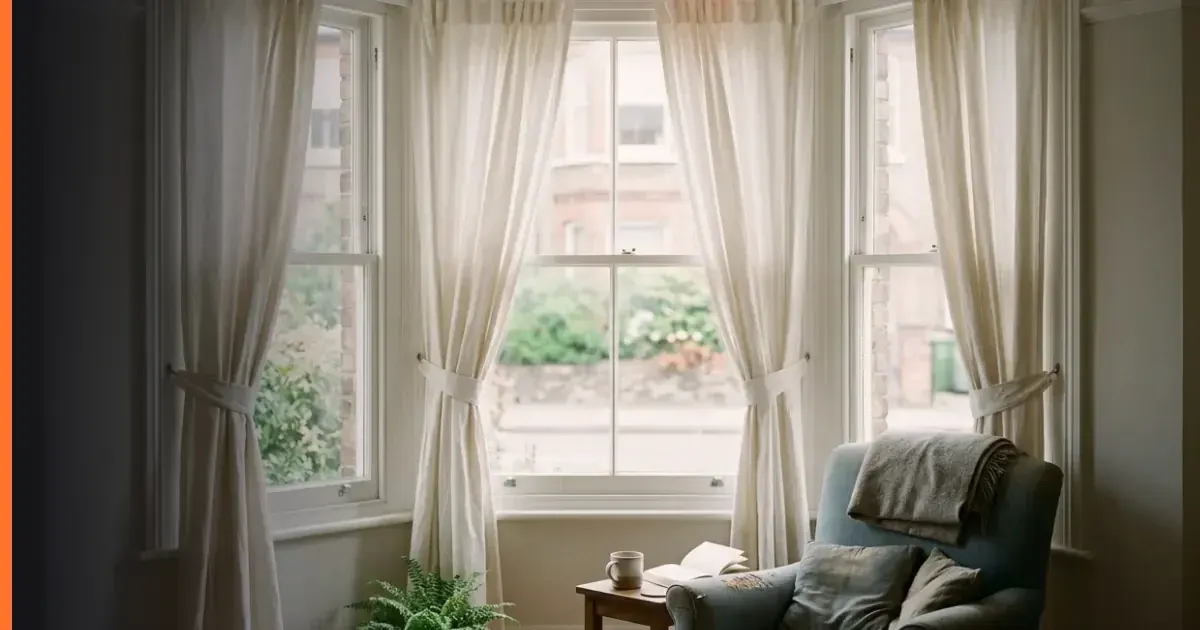
Bay windows bring architectural character and natural light, but their protruding shape and multiple angles make choosing window treatments less straightforward than dressing a flat wall. The right approach depends on whether you want to follow the bay's shape or simplify it, how much light control you need, and whether the room benefits from the window being a focal point or fading into the background. This guide walks you through the decisions that matter, from Nyde to help you work with the structure rather than against it.
Understanding your bay's structure
Bay windows fall into three main types, and each affects how curtains hang. A box bay has three flat panels—centre and two angled sides—meeting at sharp corners. A canted bay softens those angles, usually with five panels. An angled bay curves gently, with no clear corners at all. Measure the full width across the front of the bay, then measure each individual panel if you plan to follow the shape with a track.
The depth of the bay—how far it projects from the wall—matters as much as its width. A shallow bay may not leave enough room for curtains to stack back without blocking light when open. Check the space between the window frame and where a pole or track would sit: you need clearance for fabric to gather without pressing against the glass.
Ceiling height and proportion
Standard ceiling height suits curtains hung just above the frame, but if your bay reaches close to the ceiling, hanging from ceiling height makes the window feel taller and the room more spacious. Low ceilings benefit from the same trick—mount the pole or track as high as the structure allows, and let the fabric skim the floor.
Pole or track: working with the angles
A straight pole across the bay's opening simplifies everything. The curtains hang flat when closed, and you need only two panels—one drawing from each side. This approach works well when the bay is shallow, when you want clean lines, or when budget limits what you can spend on hardware. The trade-off is that the curtains won't follow the window's shape, and light may leak in at the sides unless you add a pelmet or returns.
A bay track bends to follow the window's angles, letting curtains sit close to the glass and draw around the corners. Flexible tracks suit gentle curves; rigid tracks with angled joints suit box bays. You'll need more fabric—usually three to five panels depending on the bay's configuration—and the hardware costs more than a straight pole. In return, you get precise light control and a tailored look that emphasises the bay's architecture.
Corded or manual operation
Curtains on a bay track often need a cord mechanism because the angles make reaching each panel awkward. A wand works for straight poles, but check you can reach both ends comfortably before committing. Motorised tracks solve access problems entirely, though they add cost and require power or battery access.
Fabric weight and fullness
Heavier fabrics—velvet, lined cotton, interlined wool—suit formal rooms and provide better insulation and light blocking. They need strong hardware and generous stacking space, so work best on wide bays with deep returns. Lighter fabrics—linen, unlined cotton, sheer voile—suit smaller bays or rooms where softening light matters more than blocking it. They gather more easily and need less space when open.
Fullness refers to how much fabric width you use relative to the window width. Standard fullness is twice the track or pole length, which gives soft pleats without excessive bulk. Sheer curtains can go to two and a half times the width for a more gathered look. Stiff or heavily patterned fabrics work better at one and a half times, allowing the design to show without too many folds.
Lining, interlining and thermal options
Lining protects fabric from sun damage and gives curtains more body, so they hang better and last longer. It also improves privacy and blocks more light. Blackout lining suits bedrooms and media rooms; standard lining is enough for living areas where some morning light is welcome.
Interlining—a soft layer between the face fabric and lining—adds insulation and a luxurious weight. It makes curtains quieter when drawn and helps them drape in deeper folds. The extra bulk means you need more stacking space and stronger fixings, so it suits larger bays with solid walls or ceiling joists to anchor into.
Thermal lining reflects heat back into the room in winter and reduces solar gain in summer. Bay windows often feel colder than flat walls because they have more glass area and less insulation behind them, so thermal lining makes a noticeable difference if the room is hard to heat.
Heading styles and how they affect the look
Pencil pleat headings—narrow, gathered pleats—suit most fabrics and work on both tracks and poles. They're the most adaptable and economical option. Eyelet headings have metal rings that slide onto a pole, creating soft waves and a contemporary feel; they won't work on a bay track because the rings can't turn corners.
Pinch pleat and goblet headings give a more tailored, traditional look. They need to be made to measure, with pleats hand-sewn at fixed intervals, and they hang from hooks on a track or rings on a pole. These work well on formal bays where you want the curtains to be a feature, but they cost more and take longer to make.
Tab-top and tie-top headings suit relaxed, informal rooms. They only work on poles, and drawing them is slower because the fabric doesn't glide as smoothly as a ring or hook system. Best kept for curtains that stay mostly open, like those in a breakfast room or a bay used as a reading spot.
Practical steps to get the fit right
- Measure twice. Record the bay's full width at the front, the depth from wall to window, the height from floor to ceiling or cornice, and the width of each angled section if you're using a track. Note any radiators, window sills or furniture that might interfere with fabric or fittings.
- Decide on the drop. Curtains can finish just below the sill, at radiator height or floor length. Floor length looks more generous and insulates better, but sill length works if space is tight or if a radiator sits directly beneath the bay.
- Choose your hardware before ordering fabric. The pole or track dictates how much fabric you need, where the pleats or gathers will sit, and how the curtains operate. Measure the hardware's final length—not the window's width—to calculate yardage.
- Allow for shrinkage and hems. Natural fabrics can shrink slightly after cleaning, and hems take up length. Add extra to the drop measurement—how much depends on the fabric and lining.
- Test the stack-back space. When the curtains are fully open, the gathered fabric needs somewhere to sit without blocking the window. Measure how much space you have on each side of the bay opening and make sure your chosen fullness and heading style will stack within it.
Bay windows in different rooms
Living rooms usually benefit from curtains that can be drawn fully back during the day to maximise light, then closed for warmth and privacy in the evening. A track around the bay keeps the window as a feature; a straight pole simplifies the space if the room feels busy. Pair curtains with blinds if you need flexible light control without sacrificing the view.
Bedrooms need effective blackout, which is easier to achieve with a track that follows the bay closely and curtains with blackout lining. Fitting the track inside the recess rather than across the front reduces light leakage at the edges. If the bay is small and the room feels cramped, a straight pole with simple curtains can make the space calmer.
Dining rooms and kitchens often have bays that serve as seating areas or places to display plants. Curtains here spend more time open than closed, so prioritise how they look when drawn back. Lighter fabrics and shorter drops work well, and you can layer with a voile or cafe curtain if privacy matters more than full coverage.
Alternatives to full-length curtains
Roman blinds fit inside each bay panel, keeping the window's lines clean and leaving the sill free. They're a practical choice for shallow bays or rooms where curtains would overwhelm the space. Made-to-measure blinds can follow the bay's shape precisely, but budget versions that fit standard sizes will only work if your panels happen to match.
Shutters—either full height or cafe style—suit period properties and provide excellent insulation. They fold back into the bay's recesses during the day and close flat at night. They're a significant investment but last decades and don't need cleaning as often as fabric.
Voile or sheer curtains soften the bay without blocking light. Hang them on a simple track inside the recess, and layer with blinds or shutters if you need privacy. They're a low-cost way to dress a bay while you decide on a longer-term solution.
Comparing your main options
| Approach | Best for | Light control | Cost |
|---|---|---|---|
| Straight pole | Shallow bays, modern rooms, budget installations | Moderate—light leaks at sides | Lower |
| Bay track | Deep bays, formal rooms, precise fit | Excellent—curtains sit close to glass | Higher |
| Roman blinds | Small bays, kitchens, clean lines | Good—adjustable by panel | Moderate |
| Shutters | Period homes, long-term investment | Excellent—solid panels | Highest |
Common mistakes and how to avoid them
Ordering curtains before fixing the hardware is the most frequent error. The track or pole length determines the fabric width you need, and getting it wrong means curtains that don't meet in the middle or bunch awkwardly when open. Always fit the hardware first, or at least have it in hand with final measurements confirmed.
Underestimating stack-back space leaves you with curtains that block the window even when fully drawn. Measure the gathered fabric's width when compressed, then check you have that much clear wall on each side of the bay.
Choosing fabric without considering the bay's aspect can make a room feel darker or gloomier than it needs to. North-facing bays benefit from lighter colours and sheers that let in maximum daylight; south-facing bays can take richer tones and heavier fabrics because they have light to spare. For more on working with light and colour, our guide to accent walls covers principles that apply just as well to fabric choices.
Ignoring the radiator
Curtains that drape over a radiator waste heat and can scorch. If a radiator sits under the bay, fit sill-length curtains or use a pelmet shelf to direct warm air into the room instead of up behind the fabric. Thermal lining helps, but it's not a substitute for proper clearance.
Download PDF: Bay window curtain planning checklist PDF, 29 KB
Further reading
Frequently asked questions
Can you put a normal curtain pole on a bay window?
Yes—a straight pole across the front of the bay is the simplest and least expensive option. The curtains won't follow the window's angles, so light may leak in at the sides, but the installation is straightforward and the curtains draw smoothly.
How do you measure curtains for a bay window?
Measure the full width where your pole or track will sit, then multiply by your chosen fullness—usually twice the width for standard gathers. For the drop, measure from the pole or track to where you want the curtains to finish, then add extra for hems and any shrinkage.
What is the best way to hang curtains in a bay window?
A bay track that bends to follow the window's shape gives the most precise fit and best light control, especially in deeper bays. A straight pole across the front is easier and cheaper, and works well in shallow bays or modern rooms where clean lines matter more than following the architecture.