Choosing a dining table for a small room: five practical decisions
 Save
A dining table in a small room works when you can seat the people you need and still move around it comfortably. That balance comes down to the table's shape, its width and whether it extends. The decisions are straightforward once you know what clearance you need and which shapes make the most efficient use of floor space. Nyde walks through the practicalities below.
Clearance around the table
The space between the table edge and the nearest wall or furniture determines whether someone can pull a chair out, sit down and let another person pass behind. A bare minimum clearance lets one person edge past a seated diner sideways; comfortable clearance lets two people pass without anyone standing up.
In practice: measure from the table edge to the wall or obstruction on each side. If one side has less clearance, that side becomes a bench seat or sits against the wall, and chairs go on the sides with more room.
Minimum and comfortable clearances
| Use | Clearance needed |
|---|---|
| Pulling a chair out and sitting | 75 cm |
| Passing behind a seated person | 90 cm |
| Two people passing comfortably | 110 cm |
Round or square tables
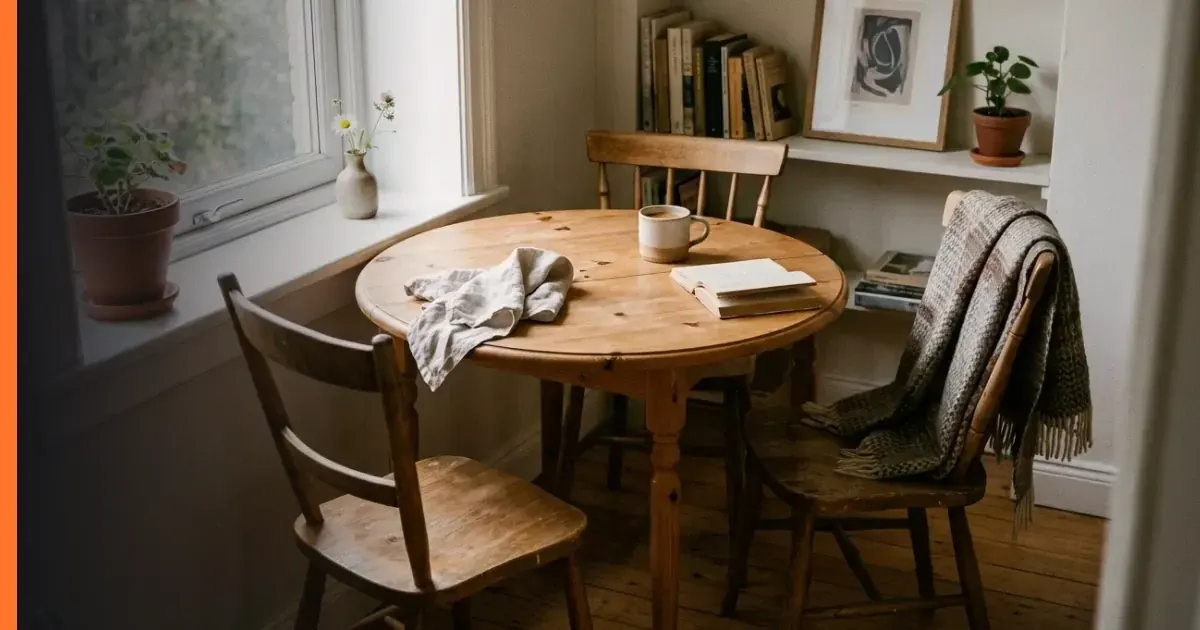
A round table seats four in less floor space than a rectangular one and has no corners to navigate in a tight room. It works well in a square room or one where the table sits in the centre rather than against a wall. The trade-off: round tables rarely extend, and seating more than four means a larger diameter that eats into your clearance.
Square tables suit two people daily and four occasionally. Pushed into a corner or against a wall, a square table frees up floor space on the open sides. An extendable square that becomes rectangular gives flexibility without a permanent footprint.
Rectangular tables and narrow widths
Rectangular tables fit more people into a long, narrow room and sit neatly against a wall when the room doubles as a hallway or kitchen. Standard width is around 90 cm, which seats people on both long sides; a narrower table of 70–80 cm still seats two opposite each other but leaves more clearance on the sides.
Worth remembering: a narrow table that extends lengthways keeps the side clearance constant while adding seats at the ends. That makes it easier to predict how the extended table will fit.
Oval tables
An oval table splits the difference: it seats more people than a round one of similar width and has no sharp corners. The curved ends make it easier to move around in a room where the table can't sit centrally. Like round tables, oval ones seldom extend.
Extendable mechanisms
An extendable table adapts to how many people are eating. Drop-leaf tables fold one or both sides down when not in use; butterfly-leaf tables store the extra leaf under the main surface and lift it into place; separate-leaf tables pull apart at the centre and slot an additional panel in.
Each mechanism has a different footprint when extended. Measure the extended length against the room to confirm there's still clearance on all sides. A table that extends but leaves no room to pull chairs out isn't usable at full size.
Seating capacity and table size
How many people the table seats depends on its perimeter and whether anyone sits at the ends. As a rough guide, each person needs around 60 cm of table edge. A rectangular table that's 120 cm long seats four with two at each end; the same table at 150 cm seats six.
In a small room, seating people only on the long sides rather than the ends can free up space at one or both ends for a sideboard or easier access to a doorway.
Pedestal bases and leg placement
A central pedestal base leaves more legroom than four corner legs and makes it easier to fit an extra chair at the end without anyone straddling a table leg. Trestle bases—two supports at either end—give similar flexibility. Tables with four legs at the corners work well when the number of diners is fixed and chairs stay in set positions.
Check where the legs or base sit when the table is extended. Some mechanisms move the legs outward, which can block the space where an extra chair would go.
Practical steps for measuring and choosing
- Measure the room and mark where the table will sit, accounting for doorways and radiators.
- Subtract clearance from each side—75 cm minimum, 90 cm for comfort—and note the remaining space for the table itself.
- Decide how many people the table seats daily and how many it needs to seat occasionally.
- Choose a shape that suits the room: round for a square room, rectangular for a long one, oval where corners are tight.
- If the occasional number is higher than the daily number, prioritise an extendable table and measure the extended size against the room before buying.
For more on fitting furniture into tight spaces, see choosing a sofa for a small living room and wardrobe choices for a small bedroom.
Disclaimer: This article is for general information only. Nyde does not sell furniture or offer design services.
Download PDF: Choosing a dining table for a small room PDF, 27 KB
Further reading
Frequently asked questions
What size dining table fits a small room?
It depends on the clearance you have. Measure from where the table will sit to the walls, subtract 75–90 cm on each side for chairs and movement, and the remaining space is your maximum table size. A table that's 120 cm long seats four; 150 cm seats six.
Are round tables better for small spaces?
Round tables seat four in less floor space than rectangular ones and have no corners, which helps in tight rooms. The downside is they rarely extend and seating more than four requires a larger diameter that reduces clearance.
How much space do you need around a dining table?
You need at least 75 cm from the table edge to the wall or furniture to pull a chair out and sit. For someone to pass behind a seated person, allow 90 cm; for two people to pass comfortably, 110 cm.